

Fifty feet equals exactly 600 inches, 16.67 yards, and 15.24 meters. That’s the same width as an NBA basketball court from sideline to sideline, or about three midsize sedans parked bumper to bumper. So how long is 50 feet in real life? It’s a distance you cross in about 20 steps, or a room-sized measurement that shows up constantly in home improvement, yard work, and online shopping.
This guide breaks down exactly what 50 feet looks like, using things you already see every day: your bedroom, your driveway, a hardware store aisle, and a football field.
Quick Conversion Table
| Feet | Inches | Yards | Meters | Centimeters | Walking Steps | Walking Time |
| 50 ft | 600 in | 16.67 yd | 15.24 m | 1,524 cm | 20–22 steps | 11–12 seconds |
The meter conversion comes from the exact international foot standard set by NIST: 1 foot equals 0.3048 meters, so 50 feet always equals 15.24 meters.
How Long Is 50 Feet Compared to a Human?
Line up 9 average adults head-to-toe (most US adults stand between 5’6″ and 5’8″) and you’ll cover close to 50 feet. On foot, it takes 20 to 22 normal steps to walk that same distance, roughly 11 to 12 seconds at a casual 3 mph pace.
How Long Is 50 Feet Visually Inside a House or Room?
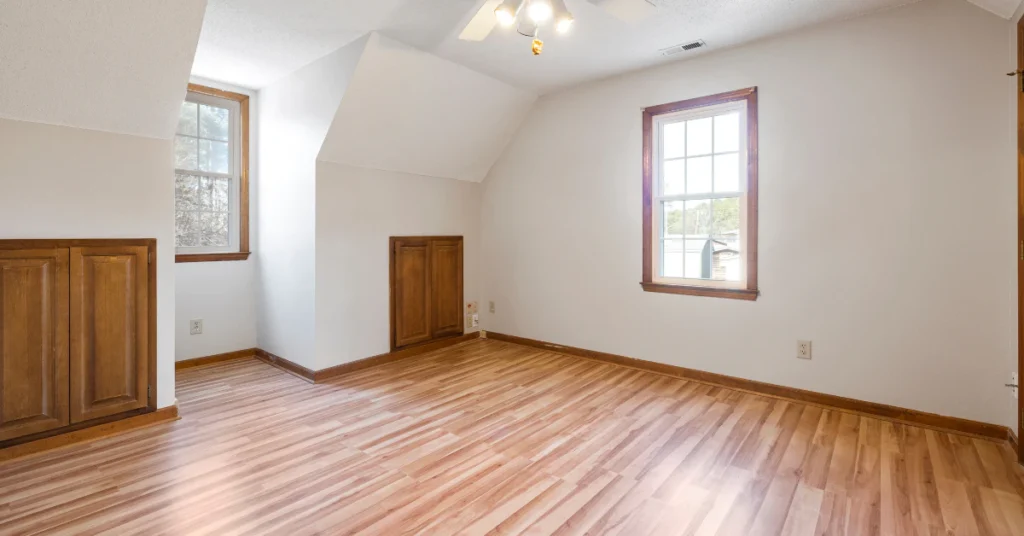
Almost no single room in an average American home stretches 50 feet in a straight line. Even a large master bedroom or living room usually tops out at 15 to 20 feet long. So when people picture how long is 50 feet visually indoors, they’re often thinking about the wrong measurement: length instead of perimeter.
Room Length vs. Room Perimeter
Here’s where the confusion starts. A 50-foot tape measure feels huge when you’re holding it, but a straight wall-to-wall run that long doesn’t exist in a typical bedroom or den.
The math works differently once you go around all four walls. A standard 12 ft × 13 ft bedroom has a perimeter of exactly 50 feet: 12 + 13 + 12 + 13 = 50 ft. That’s why a 50-foot roll of LED strip lights wraps neatly around the ceiling trim of one medium bedroom and then runs out. It won’t stretch into the hallway or a second room.
This is also the answer to how long is 50 feet in a room when people ask it from a shopping angle. They’re usually measuring for lighting, trim, or wallpaper border, and perimeter is the number that matters, not wall length.
How Long Is 50 Feet in a House?
Zoom out to the whole house, and 50 feet becomes a front-facing measurement instead. A typical suburban home with an attached 2-car garage measures 45 to 55 feet wide across the front facade. Walk that same distance front to back, and you’d pass through the entryway, living room, and kitchen before reaching a back patio door.
Here’s how 50 feet breaks down against common house zones:
- 2-car garage depth (doubled): 20–24 ft × 2 = roughly 40–48 ft
- Standard driveway length: 20–25 ft (half of a 50-foot cord or hose reach)
- Interior hallway runs: Most home hallways total 10–15 ft, so 50 feet covers 3 to 4 connected hallways
- Front house width: 45–55 ft, nearly identical to the 50-foot mark
Once you separate perimeter from straight-line length, 50 feet stops being confusing and starts making sense room by room.
Buying Guide: What Does 50 Feet Cover for LED Lights, Hoses, and Cords?

Most people don’t search for a 50-foot measurement out of curiosity. They’re staring at a product listing on Amazon or standing in a Home Depot aisle trying to figure out if 50 feet is enough. Here’s what it actually covers for the three most common purchases.
How Far Does 50 Feet of LED Lights Reach?
Think of it as the Bedroom Perimeter Rule. A 50-foot roll of LED strip lights wraps around the ceiling border of one 12 ft × 13 ft bedroom and that’s it, since that room’s perimeter already adds up to 50 feet.
Put another way, that same 50 feet covers the outline behind a 65-inch TV setup (roughly 15 feet of perimeter) plus a gaming desk (around 6 feet) with plenty of strip left over for a doorway or closet trim. What it won’t do is wrap two rooms or run down a long hallway and back.
There’s a wiring catch too. Running a single 50-foot strip on a low-voltage 12V system can cause dimming at the far end because of voltage drop. Splitting the run into two 25-foot strips, or powering the strip from the middle instead of one end, keeps the brightness even across the whole length.
How Far Does a 50-Foot Water Hose Reach?
This is where the 15% Corner Loss Rule comes in. A 50-foot garden hose reaches 50 feet on paper, but real usable straight-line reach usually lands closer to 40 to 45 feet.
That gap comes from three things: the drop from the wall spigot to ground level, slack needed to curve around flower beds, and the extra length lost going around patio furniture or a house corner. So if your yard is 45 feet deep, a 50-foot hose is the right call, not a 40-foot one.
How Long Is a 50-Foot Extension Cord in Practice?
A 50-foot cord comfortably reaches from a garage outlet down a standard two-car driveway and out to the street, or across a backyard for holiday lights and power tools.
The safety detail matters here. For anything pulling real power over that distance, like a circular saw or a space heater, go with a 12-gauge or 14-gauge cord instead of a thin 16-gauge one. Thinner cords lose voltage over 50 feet, which means less power reaching the tool and a real risk of overheating.
How Long Is 50 Feet Compared to a Football Field and Other Sports Courts?

Sports fields and courts give some of the clearest visual anchors for 50 feet, since most of them follow official measurements down to the inch.
Compared to an American Football Field
An NFL or high school football field runs 300 feet, or 100 yards, from goal line to goal line. Fifty feet works out to 16.67 yards, just over one-and-a-half first downs and roughly one-sixth of the full playing field.
Picture standing on the goal line and watching a team pick up two straight first downs. That combined distance is close to what 50 feet covers on the field.
Width of an NBA or High School Basketball Court
This is the cleanest comparison on the list. Fifty feet is the exact official width of an NBA, NCAA, and US high school basketball court, measured sideline to sideline. No rounding needed here. If you’ve ever stood on a basketball court and looked from one sideline to the other, you’ve already seen 50 feet in person.
Compared to a Bowling Lane (Clearing Up a Common Myth)
A lot of sites online claim a bowling lane is 50 feet long. That’s wrong, and it’s worth correcting.
According to official USBC rules, a regulation ten-pin bowling lane measures 60 feet from the foul line to the head pin, not 50. That means 50 feet only covers 83% of the lane, stopping about 10 feet short of the first pin.
So if you’re standing at the foul line and picture 50 feet ahead of you, you’d land just short of where the pins are set up, not on top of them.
5 Everyday Objects and Landmarks That Measure 50 Feet

Beyond sports courts and hardware store items, 50 feet also shows up in things you drive past every day. Here are five real-world objects that measure close to that exact length.
| Object | Length | Match to 50 Feet |
| 3 midsize sedans (bumper-to-bumper) | 16 ft each | 48 ft + 1 ft gaps = 50 ft |
| Semi-truck trailer (no cab) | 48–53 ft | Near-exact match |
| 5-story building | ~10 ft/floor | ~50 ft tall |
| Adult humpback whale | 45–50 ft | Matches average adult length |
| 2.5 shipping containers | 20 ft each | 50 ft combined |
Three Midsize Sedans Parked Bumper-to-Bumper
A Toyota Camry measures about 16 feet, or 192 inches, long. Line up three of them nose to tail with a 1-foot gap between each bumper, and the whole row adds up to exactly 50 feet. Next time you’re in a parking lot, count three sedans in a row and you’re looking straight at the distance.
A Highway Semi-Truck Trailer (Without the Cab)
Standard freight trailers on US interstates measure 48 feet or 53 feet long, according to Federal Highway Administration size standards. Strip away the tractor cab and just look at the trailer box itself, and you’ve got one of the most accurate real-world matches for 50 feet on the road.
A Five-Story Building
Commercial and apartment buildings typically run about 10 feet per floor, counting both the ceiling height and the floor slab. Look up at the roofline of a 5-story building and you’re seeing roughly 50 feet of vertical distance, top to bottom.
An Adult Humpback Whale
Mature humpback whales typically measure 45 to 50 feet long, with a hard maximum around 60 feet according to NOAA Fisheries. An average adult humpback is about as close to a floating 50-foot marker as nature gets.
Two-and-a-Half Shipping Containers (or One School Bus Plus a Car)
A standard intermodal shipping container measures 20 feet long, so two and a half of them lined up end to end equal 50 feet. Prefer a school bus comparison instead? A full-size yellow Type-C bus runs 35 to 40 feet long, so 50 feet is roughly one school bus plus a compact car parked behind it.
How to Estimate 50 Feet Without Any Tools
You don’t need a tape measure to get a solid estimate of 50 feet. These three methods use your own body or things already lying around your yard.
The Heel-to-Toe Walking Step Method
Walk heel to toe in a straight line, counting as you go. Twenty to 22 normal steps gets you to 50 feet, or 16 to 17 steps if you take bigger three-foot strides.
The Arm-Span (Fathom) String Trick
Stretch your arms out fingertip to fingertip. For most adults, that span roughly matches their height, usually 5.5 to 6 feet. Pull a length of cord, hose, or rope across your chest that many times, about 8.5 to 9 pulls, and you’ll land right around 50 feet.
The Parked Car Driveway Check
Use whatever’s already parked in your driveway as a giant ruler. A midsize sedan runs about 16 feet, while a full-size pickup truck measures closer to 19 or 20 feet. Line either one up against the space you’re measuring for a fast gut check.
2 Mistakes People Make When Eyeballing 50 Feet
First, height plays tricks on the eye. A vertical distance, like looking up at a building, tends to look taller than the same distance would look stretched out horizontally.
Second, don’t forget slack. When you’re eyeballing a hose or cord length, corner bends and loose curves eat up real distance, so the straight-line number is always shorter than what’s actually laid out on the ground.
Frequently Asked Questions
How many car lengths is 50 feet?
Exactly 3 standard midsize sedans, like a Toyota Camry, parked with about a foot of space between each bumper. If you’re picturing full-size pickup trucks instead, that’s closer to 2.5 trucks lined up.
How many steps equal 50 feet?
Most adults cover 50 feet in 20 to 22 average walking steps, based on a 2.2 to 2.5 foot step length. Take longer, more purposeful strides at around 3 feet each, and it drops to 16 or 17 steps.
How long does it take to walk 50 feet?
At a casual walking pace of 3 mph, or 4.4 feet per second, covering 50 feet takes about 11 to 12 seconds. That’s roughly the time it takes to unlock a phone and check a text.
Is 50 feet half of a basketball court?
Not quite, but it’s close. An NBA basketball court measures 94 feet long and exactly 50 feet wide, so 50 feet matches the full width of the court, not half its length.
Will 50 feet of LED lights go around my whole room?
Yes, as long as the room is around 12 by 13 feet or smaller, since 12+13+12+13 adds up to exactly 50 feet of wall perimeter. Bigger rooms, like a 15 by 15 foot space, have a 60-foot perimeter and will need more than one 50-foot roll.
How many stories high is 50 feet?
For a standard residential or apartment building at about 10 feet per floor, that’s roughly 5 stories. Commercial office buildings usually have higher ceilings, so 50 feet there is closer to 4 stories.
Wrapping Up
Fifty feet is easiest to picture with two anchors: indoors, it’s the full perimeter of a 12 by 13 foot bedroom, and outdoors, it’s the width of a basketball court or three sedans parked bumper to bumper.
Keep one number in mind before you buy: 50 feet on the label rarely means 50 feet of usable reach. Corners, slack, and spigot drops eat up 10 to 15% of any hose or cord, so size up when your project sits right at that edge.