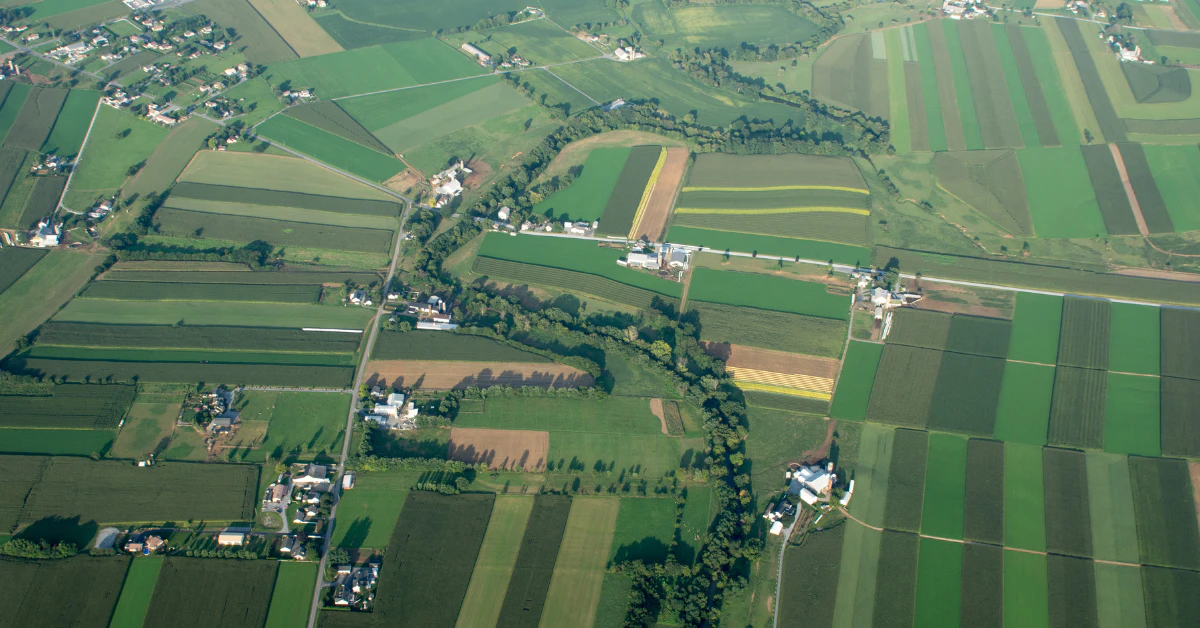
One hundred acres equals 4,356,000 square feet, or about 0.156 square miles. That’s roughly 75 American football fields lined up side by side. A square-shaped 100-acre lot would measure just over 2,087 feet on each side, which is close to seven football fields long in one direction.
So how big is 100 acres in real life? It’s big enough to hold a small farm, a hunting property, or a private off-grid retreat with room to spare. But the raw number, 4.35 million square feet, doesn’t mean much on its own. Most buyers can’t picture a figure that large.
That’s exactly why land size confuses so many first-time buyers. You see “100 acres” listed on a real estate site and have no idea if it’s walkable in ten minutes or an hour. For land buyers, hunters, and farmers across the USA, knowing the real dimensions matters. It affects fencing costs, privacy from neighbors, and how the property will actually be used day to day.
Exact Dimensions & Conversions (The Math Made Simple)
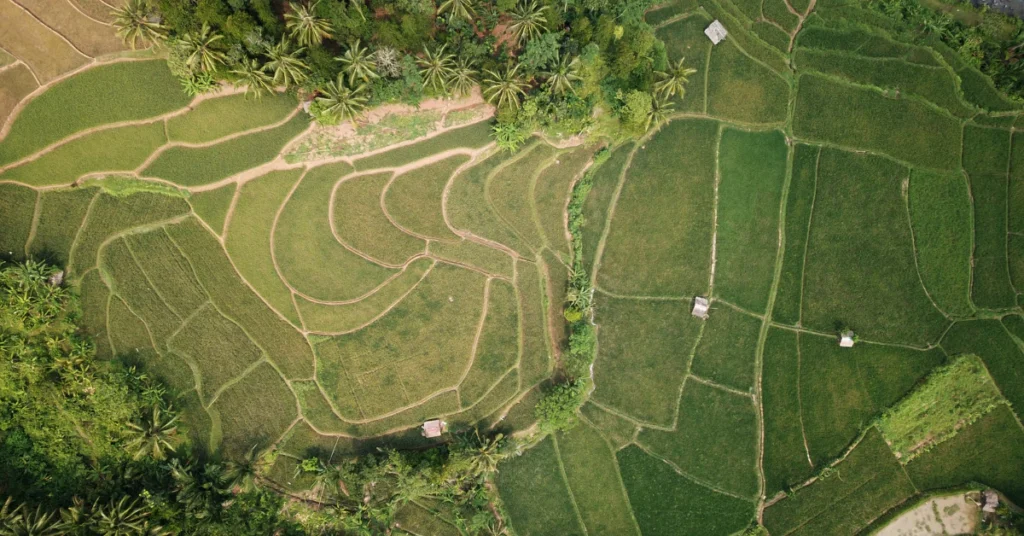
Land math gets easier once you break it into simple steps. One acre always equals 43,560 square feet. Multiply that by 100, and 100 acres to square feet comes out to exactly 4,356,000 square feet.
That’s a lot of ground. But numbers like millions of square feet are hard to picture. Converting to square miles helps put things in perspective.
100 acres in square miles works out to 0.15625 square miles. Think of it as roughly one-sixth of a single square mile. For readers more familiar with metric units, 100 acres also equals about 40.47 hectares.
Here’s a quick reference table for the most common conversions:
| Unit | Equivalent |
| Square Feet | 4,356,000 sq ft |
| Square Miles | 0.15625 sq mi |
| Hectares | 40.47 ha |
| Square Yards | 484,000 sq yd |
These figures follow standard land measurement conventions used across the United States, based on definitions maintained by the National Institute of Standards and Technology.
Now for the physical shape. If you took 100 acres and laid it out as a perfect square, each side would measure about 2,087.1 feet. That’s just under half a mile per side.
Walk the full perimeter of that square, and you’d cover roughly 8,348 feet, or about 1.58 miles. At a normal walking pace of 3 mph, crossing straight through the middle of the property would take about 8 minutes.
Of course, real land is rarely a perfect square. Most 100-acre parcels are rectangular, irregular, or split by roads, creeks, or tree lines. Knowing the “ideal square” version still gives buyers a solid mental anchor. It’s the baseline every real-world shape gets compared against.
What Does 100 Acres Look Like? (Real-World Comparisons)

Numbers on paper only go so far. The fastest way to grasp land size is to compare it to things people already know.
Football fields are the go-to American yardstick for land size. A full football field, including both end zones, covers 57,600 square feet.
Do the math, and 100 acres in football fields comes out to about 75.6 fields. That means you could line up more than 75 football fields, goal line to goal line, and still have room left over.
Here’s how that stacks up:
- 1 acre = about 0.76 football fields
- 10 acres = about 7.6 football fields
- 50 acres = about 37.8 football fields
- 100 acres = about 75.6 football fields
Landmarks offer another useful comparison. Vatican City, the smallest country in the world, covers 109 acres. That means 100 acres is nearly the size of an entire sovereign nation. It’s a striking way to explain what does 100 acres look like to someone who has never stood on farmland or hunting property.
Suburban housing gives a more everyday comparison. Most suburban house lots range from about 0.2 to 0.25 acres, depending on the region and neighborhood.
At that size:
- A typical suburban block might hold 20 to 25 homes per acre of total land.
- Scale that up to 100 acres, and you could fit over 400 single-family homes with yards.
- Some denser developments could squeeze in even more.
That single comparison tells buyers a lot. A 100-acre property isn’t just “big.” It’s an entire neighborhood’s worth of land compressed into one parcel, or in the case of a farm or hunting property, one continuous stretch of open space.
For hunters and land buyers used to city lots, this scale can be hard to grasp at first. A quarter-acre yard feels normal. A hundred acres feels like a different world entirely, more like a small nature preserve than a backyard.
Rural buyers often ask how many football fields, homes, or landmarks it would take to match what they’re looking at online. These comparisons answer that question directly, without requiring any math on the reader’s part.
How Long Does It Take to Walk 100 Acres?

This is one of the most common questions land buyers ask. Numbers on a listing don’t tell you what it feels like to actually stand on the property. Walking time does.
Picture the dimensions of 100 acres as a perfect square. Each side would measure about 2,087 feet. That’s just under four-tenths of a mile.
Walking straight across the middle of that square, at a normal pace of about 3 mph, takes roughly 8 minutes. That’s the shortest path from one edge to the other.
Walking the full boundary is a bigger job. The total perimeter of a square 100-acre lot comes out to about 8,348 feet, or roughly 1.58 miles. At a normal walking pace, covering that entire fence line would take about 30 to 35 minutes.
Terrain changes this, of course. Hills, thick brush, creeks, or fencing can slow things down. A flat, cleared field walks much faster than wooded or hilly ground.
This size has a big effect on privacy too, which is one of the top concerns for buyers moving out of cities and suburbs.
If you build a house in the middle of a square 100-acre lot, your closest property edge sits over 1,000 feet away in every direction. That’s more than three football fields between your front door and your property line.
Practically speaking, this means:
- No visible neighbors in most directions, especially with trees or natural buffers.
- Reduced noise from roads, traffic, or nearby homes.
- Room for a long private driveway, separating your house from public roads.
For hunters, this same distance means more undisturbed land for wildlife to move through. For farmers, it means more buffer space between operations and any neighboring property. Either way, 100 acres gives enough physical distance that privacy stops being a daily concern.
What Can You Actually Do With 100 Acres?

Land size only matters if it fits your plans. A hundred acres is large enough to support several different lifestyles, depending on what a buyer wants out of it.
Here’s how that space typically breaks down by use case:
Farming & Agriculture
- Enough room for a small to medium-sized crop operation, growing corn, soybeans, hay, or other row crops.
- Suitable for grazing 20 to 50 head of cattle, depending on grass quality and rotation practices.
- Room to separate fields, add irrigation, or rotate crops season to season without running out of space.
Hunting & Recreation
- Plenty of room for private trails, food plots, and multiple hunting blinds or tree stands.
- Enough distance between stands to avoid disturbing wildlife across the whole property.
- Space to add a pond, shooting range, or ATV trails without cramming everything into one corner.
Homesteading & Off-Grid Living
- Maximum privacy, with enough distance from neighbors to build wherever feels right.
- Room for a large solar array, without shading issues from nearby structures or trees.
- Space to manage timber, firewood, and even a small woodlot for long-term self-sufficiency.
Real Estate Development
- Large enough to subdivide into ten separate 10-acre ranchettes, or twenty 5-acre lots.
- Appeals to developers targeting buyers who want rural land without needing a full 100-acre commitment.
- Flexible enough to sell off portions over time while still keeping a private section for personal use.
Not every 100-acre property fits all four categories equally well. Terrain, soil quality, water access, and local zoning all shape what’s realistic. Flat, cleared land suits farming best. Wooded, hilly terrain often favors hunting or homesteading instead.
Before buying, it helps to walk the land itself and match its natural features to your actual goals, rather than relying on acreage alone.
Final Thoughts
A hundred acres works out to 4.35 million square feet, or about 75 football fields lined up end to end. That’s the scale we’ve covered throughout this guide, broken down into distances, walking times, and everyday comparisons.
Numbers aside, what this size really offers is freedom. It’s enough land for total privacy, room to farm, hunt, build off-grid, or simply own space that feels like your own world.
Few properties give buyers this much flexibility. Whether the goal is raising cattle, managing timber, or just walking outside without seeing another house, 100 acres delivers room to grow into those plans over time.
It’s not just a number on a listing. It’s a genuine landmark of land ownership, one that few people ever get to experience firsthand.
Frequently Asked Questions
How big is 100 acres in square feet?
100 acres equals exactly 4,356,000 square feet, based on the standard conversion of 43,560 square feet per acre.
How many football fields is 100 acres?
100 acres holds about 75.6 American football fields, including the end zones, which each measure 57,600 square feet.
How many square miles is 100 acres?
100 acres equals 0.15625 square miles, or roughly one-sixth of a single square mile.
How long does it take to walk 100 acres?
Walking straight across a square 100-acre lot takes about 8 minutes at a normal pace. Walking the full perimeter, about 8,348 feet, takes roughly 30 to 35 minutes.
What are the dimensions of a square 100-acre lot?
A perfect square 100-acre parcel measures approximately 2,087 feet on each side.
How many houses can fit on 100 acres?
Since typical suburban lots run 0.2 to 0.25 acres, 100 acres could hold over 400 single-family homes with yards.