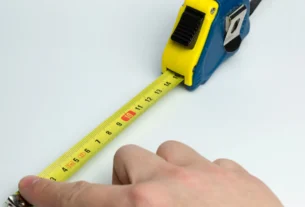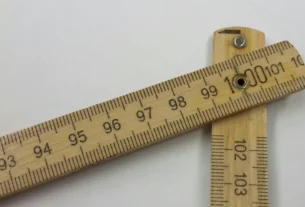
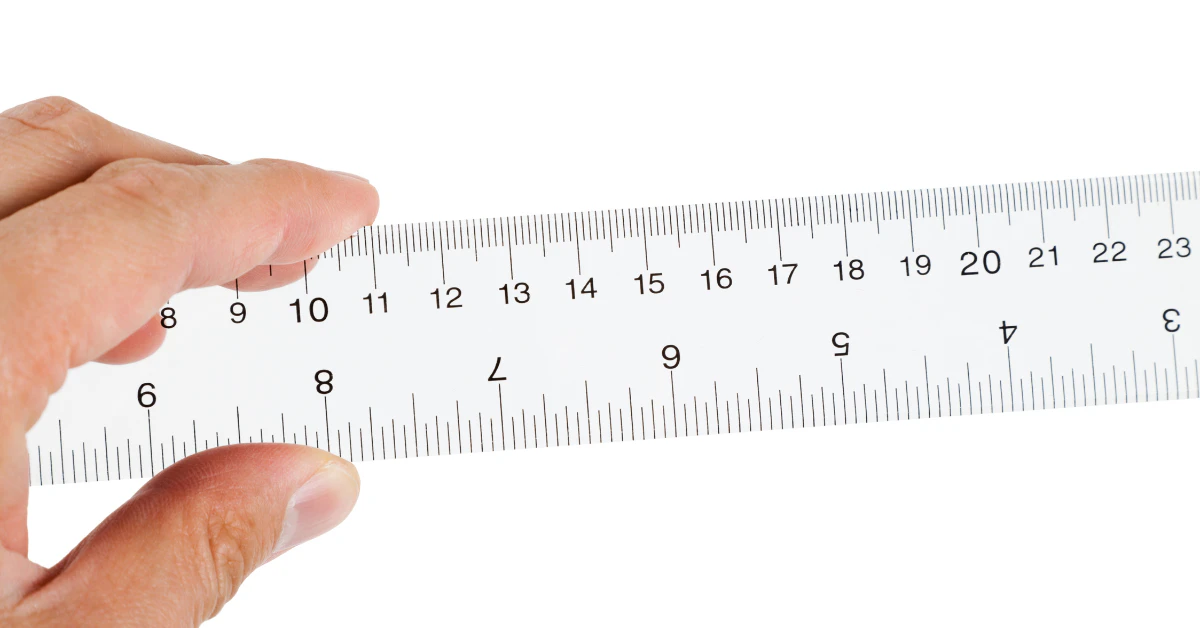
One centimeter equals 0.3937 inches, or 10 millimeters. That’s how long is 1 cm in plain numbers. On a US tape measure, the closest standard mark is 3/8 inch (0.375 in), just shy of true size. A US penny comes close too: its radius, the distance from Lincoln’s face to the rim, measures 9.525 mm. For a quick visual check, hold up an adult pinky fingernail or the flat end of a AAA battery; both land right around 1 cm wide.
Americans run into trouble here because the metric system works in tens, while US rulers split everything into halves, quarters, and sixteenths. A centimeter is simply 1/100th of a meter, the base unit the rest of the world builds length from. The official U.S. standards body, NIST, defines this conversion using the exact relationship that 1 inch equals 2.54 cm by law, not by rough estimate. That’s why 1 cm converts to a repeating decimal (0.39370079 in) instead of a clean inch fraction, and why reading cm on a US ruler takes a small mental shortcut instead of a direct line match.
The table below lines up every common unit against 1 cm, so you can match it to whatever measuring tool happens to be sitting on your desk right now.
1 Centimeter in Common US & Metric Units
| Unit of Measurement | Exact Equivalent to 1 cm | Practical Everyday Context |
| Millimeters | 10 mm | Width of ten tiny ruler ticks |
| Inches (Decimal) | 0.3937 in | Rounds to 0.39 or 0.4 inches |
| Inches (US Ruler Fraction) | ~3/8 in (0.375 in) | Closest standard tape measure line |
| Meters | 0.01 m | 1/100th of a full meter stick |
| Feet | 0.0328 ft | A sliver of a 12-inch ruler |
| Yards | 0.0109 yd | A tiny fraction of a yardstick |
Where Is 1 cm on a Standard US Ruler? (The 3/8-Inch Trick)

Most US tape measures and household rulers only mark inch fractions: 1/2, 1/4, 1/8, and 1/16. There’s no line labeled “1 cm,” so when a product listing says 0.39 inches, a lot of people just stare at the ruler, unsure where to look. The good news is there’s one fraction that solves this almost perfectly.
That fraction is 3/8 inch. In decimal form, 3/8 inch equals 0.375 inches, or 9.525 mm. True 1 cm is 0.3937 inches, or 10 mm. The gap between them is just 0.475 mm, less than the thickness of a single sheet of paper. That makes the 3/8-inch mark roughly 95 percent accurate as a stand-in for 1 cm, close enough for shopping, crafting, or a quick school project.
For comparison, the next line up, 7/16 inch, equals 0.4375 inches (11.11 mm). That overshoots 1 cm by more than a full millimeter, noticeably too generous. So when you’re stuck between two inch lines and need a cm estimate, round down to 3/8, not up to 7/16.
If your ruler has a metric side printed along the edge, skip the fraction math entirely. Count ten of the small millimeter ticks starting from the 0 line, not the plastic edge of the ruler, since manufacturing tolerances can shave a hair off the very end. That ten-tick span is your true 1 cm, no rounding needed.
1 cm vs. Nearby Inch Fractions on a Tape Measure
| Measurement | Decimal Inches | Millimeters |
| 1/4 inch | 0.250 in | 6.35 mm |
| 3/8 inch | 0.375 in | 9.525 mm |
| 1 cm (Exact) | 0.3937 in | 10.0 mm |
| 7/16 inch | 0.4375 in | 11.11 mm |
| 1/2 inch | 0.500 in | 12.7 mm |
12 Everyday Things That Are About 1 Centimeter Long

Every object below has been checked against real manufacturing specs, not guesswork, so you know exactly what looks like 1 cm the next time you need a fast visual reference. These are things that are 1 centimeter long and sitting within arm’s reach in most American homes right now.
Quick Summary Reference Table
| Everyday Object | Which Part to Look At | Exact Size (mm & cm) |
| Pinky fingernail | Width across the nail bed | 9–11 mm / 0.9–1.1 cm |
| Dress shirt button | Diameter across the face | 10.16 mm / 1.0 cm |
| Pain reliever caplet | Width across the flat middle | 8–10 mm / 0.8–1.0 cm |
| Sugar cube | Any single edge | 10 mm / 1.0 cm |
| Jumbo boba straw | Outer diameter of the opening | 10 mm / 1.0 cm |
| Blueberry or coffee bean | Width across the widest point | 10–11 mm / 1.0–1.1 cm |
| AAA battery | Diameter of the flat end | 10.5 mm / 1.05 cm |
| Heavy-duty staple | Leg length or crown width | 9.3–10 mm / 0.93–1.0 cm |
| BIC Cristal pen cap | Width across the cap ring | 9–10 mm / 0.9–1.0 cm |
| LEGO brick | Height of the plastic wall | 9.6 mm / 0.96 cm |
| 5 stacked nickels | Height of the coin stack | 9.75 mm / 0.975 cm |
| Base-10 math cube | Any single edge | 10 mm / 1.0 cm |
Around Your Body & Wardrobe
- Adult Pinky Fingernail Width (9–11 mm / 0.9–1.1 cm): Measure side to side across the nail bed of your pinky, not your index finger or thumb. Those run much wider, closer to 1.3 to 2 cm, and will throw your estimate off badly.
- Standard Men’s Dress Shirt Button (10.16 mm / 1.0 cm): Collar and placket buttons on most dress shirts follow the garment industry’s 16 Ligne standard. Pinch one between two fingers and you’re holding an almost perfect 1 cm disc.
- Pain Reliever Caplet Width (8–10 mm / 0.8–1.0 cm): Look across the short, flat middle of a standard coated acetaminophen or Tylenol caplet. The length runs longer, but that middle width sits right at the 1 cm mark.
In Your Kitchen & Pantry
- A Small Café Sugar Cube (10 mm × 10 mm × 10 mm / 1.0 cm): This one’s a true cubic centimeter, equal to 1 mL in volume, with every edge measuring exactly 1 cm. Grab one from a coffee shop counter for a reliable 3D reference.
- Jumbo Smoothie or Boba Straw Diameter (10 mm / 1.0 cm): Check the outer opening of a wide boba straw against a regular soda straw, which measures closer to 6 mm. The difference is obvious once you line them up side by side.
- A Medium Blueberry or Large Coffee Bean (10–11 mm / 1.0–1.1 cm): A plump fresh blueberry or a roasted Arabica bean from a screen-size-19 batch both land in this range. Roll one between your fingers to feel roughly how wide 1 cm actually is.
On Your Office Desk
- AAA Battery Diameter (10.5 mm / 1.05 cm): Pull a AAA battery from any remote or flashlight and look at the flat metal circle on either end. That round face is one of the easiest 1 cm references in the entire house.
- Heavy-Duty Staple Leg or Mini Staple Crown (9.3–10 mm / 0.93–1.0 cm): The vertical leg on a heavy-duty stapler’s staple, or the top crown width of a compact No. 10 staple, both hover right around 1 cm. Open a staple out flat to see it clearly.
- BIC Cristal Pen Cap Width (9–10 mm / 0.9–1.0 cm): The hexagonal barrel itself runs 8.3 to 9 mm, but once you add the cap ring, the total width lands close to a full centimeter. Check it against the cap, not the bare barrel.
Games, Toys & Pocket Change
- Standard LEGO Brick Height (9.6 mm / 0.96 cm): Measure the vertical plastic wall of a classic LEGO brick from the bottom edge up to the flat top, leaving out the raised stud on top. That wall alone is just shy of 1 cm.
- Five Stacked US Nickels (9.75 mm / 0.975 cm): Each nickel runs 1.95 mm thick, so five stacked flat on a table reach 9.75 mm, within a quarter millimeter of true size. It’s one of the most precise DIY references available.
- Classroom Base-10 Centimeter Cube (10 mm / 1.0 cm): The small plastic counting cube used in elementary math lessons weighs about 1 gram and measures exactly 1 cm on every side. If you have kids, check the school supply bin first.
How to Measure 1 cm Without a Ruler (4 Accurate DIY Methods)

Sometimes you need a close estimate right now, with nothing but what’s in your wallet or on your desk. These four methods use everyday US items to get you within a hair of true 1 cm.
The 5-Nickel Coin Stack Method (97.5% Accurate)
According to the U.S. Mint’s official coin specifications, one nickel measures 1.95 mm thick. Stack five of them flat on a table and the math works out clean: 5 × 1.95 mm = 9.75 mm, or 0.975 cm. That’s as close to a true centimeter as pocket change can get.
No nickels handy? Pennies work too, just less precisely. One penny is 1.52 mm thick, so 6 stacked pennies reach 9.12 mm and 7 reach 10.64 mm, bracketing 1 cm from both sides. A single penny’s radius, the distance from the rim to Lincoln’s head, also lands near 9.525 mm.
The AAA Battery Stamp Trick (95% Accurate)
Pop a AAA battery out of any TV remote. Stand it upright on a sheet of paper and trace two small dots on opposite sides of its flat, circular base. That diameter measures 10.5 mm, just a touch over 1 cm, and gives you an instant dot-to-dot reference you can reuse anytime.
The Smartphone Screen Calibration Method
Open a free full-screen ruler app calibrated to your phone’s exact pixel density, and it’ll show a true 1 cm line on screen. No app handy? Compare against a USB-A cable’s metal tip, which measures 12 mm wide. Subtract about 2 mm, roughly the height of a nickel stood on edge, and you’re close to 1 cm.
The US Printer Paper Folding Hack
Standard US Letter paper measures 8.5 by 11 inches, or 21.6 by 27.94 cm. Fold the 8.5-inch edge in half four times in a row, and each resulting section measures about 1.35 cm. Trim that folded edge down slightly and you’ve got a rough pinch-width guide for 1 cm in a pinch.
3 Everyday Objects People Mistakenly Think Are 1 cm (And Why They Are Off)

A lot of measurement blogs repeat the same wrong comparisons without checking the actual specs. Here’s what’s really going on with three of the most common ones.
“A Standard #2 Yellow Pencil Is 1 cm Thick.” A standard yellow Dixon Ticonderoga #2 pencil actually measures only 7.2 mm to 7.6 mm across, nearly 25 percent too small to count as 1 cm. The pencil that does hit true size is the thicker “My First” jumbo beginner pencil, at 10.3 mm wide. If you’re grabbing a pencil off your desk for a quick reference, you’re almost certainly holding the wrong one.
“A Laptop USB Port Is 1 cm Tall.” A standard rectangular USB Type-A port opening is only 4.5 mm tall, less than half a centimeter. The dimension that’s actually close to 1 cm is the port’s width, at 12 mm, not its height. Mixing those two up is one of the most repeated errors in online measurement guides.
“Any Adult Fingernail Is 1 cm Wide.” Your thumbnail runs 1.6 to 2.0 cm wide, and your index fingernail sits around 1.3 to 1.5 cm, both far too large for an accurate 1 cm guess. The one nail that actually works is your pinky, at 0.9 to 1.1 cm across the nail bed. Reach for the smallest finger, not the most convenient one.
How 1 cm Scales Up
| Size | Millimeters | Real-World US Reference |
| 0.5 cm | 5 mm | A pencil eraser’s width |
| 1 cm | 10 mm | A pinky fingernail or AAA battery end |
| 2 cm | 20 mm | A US quarter’s diameter, roughly |
| 2.54 cm (1 inch) | 25.4 mm | A US quarter is 24.26 mm, just under |
| 5 cm | 50 mm | About 2 inches, a golf ball’s width |
Frequently Asked Questions
What is 1 cm in inches exactly?
One centimeter equals 0.3937 inches, roughly 2/5 of an inch, calculated by dividing 1 by 2.54. On a standard US tape measure, the closest physical line is 3/8 inch (0.375 in), close enough for almost any everyday task.
Is 1 cm bigger or smaller than 1/2 inch?
Smaller. Half an inch equals 1.27 cm (12.7 mm), which makes 1 cm (10 mm) about 2.7 millimeters shorter than 1/2 inch. That gap is roughly the thickness of a US nickel.
Which finger is closest to 1 cm wide?
The pinky fingernail on most adults measures 0.9 to 1.1 cm across the nail bed. The index fingertip runs noticeably wider, typically 1.3 to 1.6 cm, so it’s an unreliable stand-in for a quick cm check.
How many pennies stacked together equal 1 cm?
Either 6 or 7 US pennies. One penny measures 1.52 mm thick, so 6 stacked reach 9.12 mm (0.91 cm) and 7 reach 10.64 mm (1.06 cm). For a tighter match, stack 5 nickels instead, which land at 9.75 mm.
How big is a 1 cm spot or mole on the skin?
In dermatology and first aid, a 1 cm (10 mm) mark is roughly the diameter of a flat AAA battery end or a standard men’s shirt button, noticeably larger than a typical 6 mm pencil eraser.
Final Thoughts
Keep three anchors in mind: the 3/8-inch mark on your tape measure, five stacked nickels in your pocket, and your own pinky fingernail. Between those three, you’ll never be stuck guessing at 1 cm again.