Lining up five US quarters does not make 5 inches. The row measures 4.775 inches (121.3 mm), which is 0.225 inches (5.7 mm) short. So, how long is 5 inches? It is exactly 12.7 centimeters (127 mm).
Five inches is one inch short of half a foot (6 inches, or 15.24 cm). Each US quarter is 0.955 inches wide (24.26 mm), so five of them fall just under the mark.
When I need to measure something small for a DIY project and my ruler is nowhere near, I reach for coins. I always check a shortcut against real specs first, because a small miss can ruin a cut.
In this guide, I share exact, everyday objects that help you see 5 inches fast. Each one has US and metric sizes. I also flag items that vary by brand, so you know which ones to trust.
4 Everyday Items That Are Exactly 5 Inches Long

When I need a true 5 inches fast, I start with items made to a fixed size. Most objects are only close to 5 inches. These four are not. Each one is 5.0 inches (12.7 cm) on at least one side, and I explain how to use it below.
Standard 3 by 5 Index Card
The long side of a 3 by 5 index card is 5 inches (12.7 cm). The short side is 3 inches (7.62 cm). This is a common trade size in the US, so most brands match it, but I still check a new pack with a ruler once.
It is useful because you can hold it, mark it, and carry it. I suggest keeping one in your toolbox and using its long edge as a quick 5 inch gauge for spacing, cuts, and crafts.
40d Common Nail
A 40d common nail is 5 inches (127 mm) long. The “d” is short for penny, from an old coin called the denarius. Length means the shank, which is the part below the head. Thickness varies by maker, from about 0.225 to 0.238 inches (5.7 to 6.0 mm).
This one is handy for DIY planning. Lay it against a board to see how deep a 5 inch nail goes. Keep your fingers clear of the sharp tip.
Two Poker Cards Side by Side
A standard poker size card is 2.5 inches (63.5 mm) wide and 3.5 inches (88.9 mm) tall. Place two cards side by side on their short edges, and the row is exactly 5 inches (127 mm).
Check the size first. Bridge cards are narrower, at 2.25 inches (57.15 mm), so two of them make only 4.5 inches (114.3 mm). Most casino and everyday decks are poker size, but the size can vary slightly by brand.
I like this one because a deck is easy to find at home, and it lets you see 5 inches on a table with no ruler.
Smallest Mailable USPS Postcard
The smallest mailable USPS postcard is at least 5 inches (12.7 cm) long and 3.5 inches (8.89 cm) high. It must also be at least 0.007 inches (0.18 mm) thick to get the postcard price. Length is the side that runs parallel to the address.
Postcards can be up to 6 inches (15.24 cm) long and 4.25 inches (10.8 cm) high, so only the minimum is exactly 5 inches long.
These four items are rare. Most things people call 5 inches are really a bit shorter or longer, like five quarters at 4.775 inches (121.3 mm). Use these four first when accuracy really matters. The next sections cover near misses and how far off each one is.
If you can only grab one, I suggest the index card, since it is flat, light, safe to handle, and easy to find.
Money and Wallet Items Compared to 5 Inches
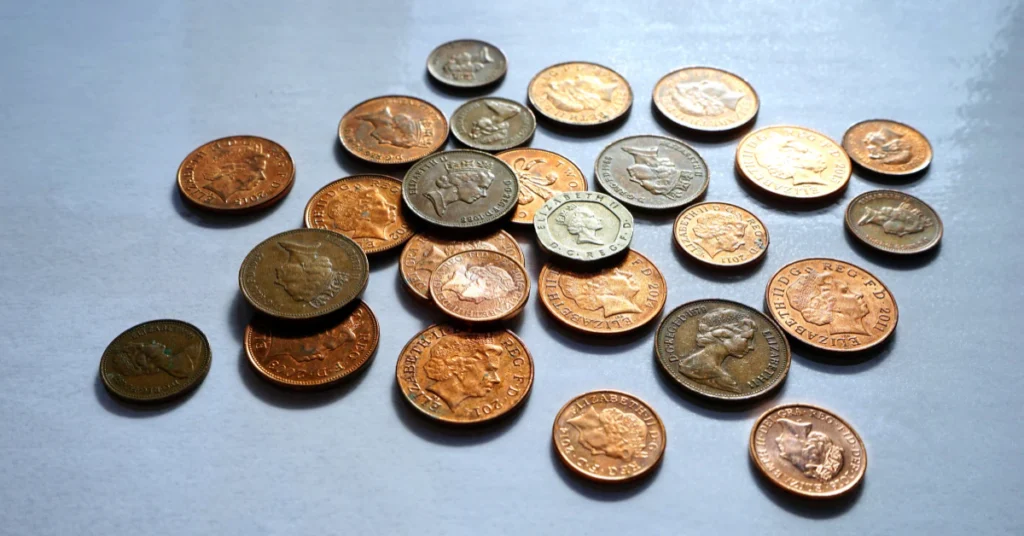
Grab your wallet and empty out your pocket change. You may already have what you need to measure 5 inches. Coins, bills, and cards have fixed sizes, and I use them for quick checks when a ruler is out of reach. Here is the math for each one, using sizes from the US Mint, the US Treasury, and the ISO card standard.
Six US Nickels in a Row
Six US nickels in a row are the closest coin match to 5 inches. A nickel is 0.835 inches wide (21.21 mm). Six times 0.835 inches is 5.010 inches (127.26 mm).
That is only 0.010 inches (0.26 mm) over. Line the coins edge to edge with no gaps, and use a book edge to keep the row straight. Small gaps add up over six coins.
Federal law sets the nickel’s width at 0.835 inches, so you can trust the number.
Seven US Dimes in a Row
A dime is 0.705 inches wide (17.91 mm). Seven times 0.705 inches is 4.935 inches (125.4 mm). That is short of 5 inches by 0.065 inches (1.6 mm), about the thickness of two credit cards.
Dimes are the smallest circulating US coin by width, so seven fit in a tight row. This is a good backup if you do not have six nickels.
Five US Quarters in a Row
This is the myth from the start of this guide. A quarter is 0.955 inches wide (24.26 mm). Five times 0.955 inches is 4.775 inches (121.3 mm). That is 0.225 inches (5.7 mm) short of 5 inches.
The number 5 matches, but the size does not. Six quarters are 5.73 inches (145.6 mm), so no whole number of quarters works.
Five US One Dollar Coins in a Row
The US one dollar coin is 1.043 inches wide (26.49 mm). Five times 1.043 inches is 5.215 inches (132.5 mm). That is 0.215 inches (5.5 mm) over 5 inches.
This row runs long, so it works as an upper limit: an object that fits inside five dollar coins is under 5.215 inches. Pair it with seven dimes to bracket 5 inches.
A US One Dollar Bill
A US one dollar bill is 6.14 inches long (156 mm) and 2.61 inches wide (66.3 mm). All US paper bills printed since 1929 share this size. To compare, divide 5 by 6.14. The answer is 0.81, so 5 inches is about 81 percent of a bill’s length.
The bill is 1.14 inches (29 mm) longer than 5 inches. Two bills laid side by side on their short edges make 5.22 inches (132.6 mm), a near miss. Use a bill as a guide that is just over 5 inches, not as an exact tool.
Test it: line up one end of a bill with one end of a 3 by 5 index card. The bill runs past the card’s 5 inch edge by 1.14 inches (29 mm).
A Standard Credit Card
A standard credit card is 3.370 inches long (85.60 mm) and 2.125 inches wide (53.98 mm). This size comes from the ISO 7810 ID-1 standard, so most credit and debit cards match it. Some sources round the length to 3.375 inches (3 and 3 eighths), which is a tiny difference.
One and a half cards is 1.5 times 3.370 inches, which is 5.055 inches (128.4 mm). That is 0.055 inches (1.4 mm) over 5 inches. Lay one card down, then add half of a second card. This is handy because almost everyone carries a card.
Here is the ranking from closest to farthest. Six nickels are 0.010 inches over, and one and a half credit cards are 0.055 inches over. Seven dimes are 0.065 inches short. Five dollar coins are 0.215 inches over, and five quarters are 0.225 inches short.
I also checked pennies and half dollars. Seven pennies make 5.25 inches (133.4 mm), and four half dollars make 4.82 inches (122.4 mm). Nickels still win among coins.
When I want a fast check, I use six nickels first. If I only have a card, I use one and a half cards. I confirm with a ruler.
Technology and Screens: The Diagonal Confusion
A 5 inch phone is not 5 inches long. The label 5 inch is a diagonal screen size, not the length of the phone or even the length of the screen. This one mix up leads shoppers to buy cases and screen protectors that do not fit. Here is how the numbers really work.
A 5 Inch Screen Measured Diagonally
A diagonal runs from one corner of the screen to the opposite corner. That line is longer than the length or the width, just like the slanted line across a sheet of paper is longer than either side. For a 16 by 9 screen, the long side is about 87 percent of the diagonal. So a 5 inch 16 by 9 screen is about 4.36 inches (11.07 cm) long and 2.45 inches (6.22 cm) wide.
The shape matters. A taller 20 by 9 screen with a 5 inch diagonal is about 4.56 inches (11.58 cm) long and 2.05 inches (5.21 cm) wide. These numbers come from the Pythagorean theorem, and they describe the screen only. The phone body is bigger because of the frame around the glass.
iPhone 13 mini
The iPhone 13 mini came out in 2021. Apple lists it at 5.18 inches (131.5 mm) tall and 2.53 inches (64.2 mm) wide. Its screen is called 5.4 inches, yet the whole phone is shorter than 5.4 inches.
That makes it a near match to 5 inches. It is only 0.18 inches (4.5 mm) longer.
iPhone SE 3rd Generation
The iPhone SE 3rd generation came out in 2022. Apple lists it at 5.45 inches (138.4 mm) tall and 2.65 inches (67.3 mm) wide. Its screen is only 4.7 inches on the diagonal.
So the SE has a smaller screen than the 13 mini, but a taller body. Thick borders above and below the screen add the extra length. It is 0.27 inches (6.9 mm) taller than the 13 mini and 0.45 inches (11.4 mm) over 5 inches.
Three AAA Batteries End to End
Battery makers list a AAA cell at 44.5 mm (1.75 inches) long. Three in a row, with the flat end of one against the button end of the next, measure 133.5 mm. That is about 5.26 inches, or 0.26 inches (6.5 mm) over 5 inches.
Length can vary slightly by brand, so treat 5.26 inches as a typical result, not a promise. I like this check because batteries are easy to find in a kitchen drawer.
I think screen sizes trick shoppers because the number sounds like a ruler measure. A listing that says 5 inches feels like it should be 5 inches long, but it is not. Before I buy a case or a stand, I look at the listed height and width, not the screen size. Then I always match the exact model name.
Household Objects and Stationery Size Comparisons
Say you are working at your desk and need to mark 5 inches, but your ruler is in another room. Look at what is already around you. Photos, a passport, a pencil, and a sheet of paper all have known sizes, and I use them as backup rulers. Here are seven everyday objects and how close each one is to 5 inches.
Standard 5 by 7 Photo Print
The short side of a 5 by 7 photo print is exactly 5 inches (12.7 cm). The long side is 7 inches (17.78 cm). This is a common print size in the US.
Frames labeled 5 by 7 can show a smaller area because the rim covers the edges. That varies by frame, so measure the print itself. If you have a spare print, you have a clean 5 inch edge. Hold it against your object, or trace the short edge on paper to make a template.
US Passport Book
A US passport book is 4.921 inches (125 mm) tall and 3.465 inches (88 mm) wide. That matches the international ID-3 size used for passports. It is 0.079 inches (2 mm) shy of 5 inches, which is less than the thickness of three credit cards.
Its width helps too: 3.465 inches (88 mm) is close to a poker card’s 3.5 inches (88.9 mm). This makes it one of the closest objects to 5 inches that most people own. Still, check yours with a ruler, because designs can change over time.
Standard 12 Ounce Soda Can
A standard 12 ounce soda can is typically 4.83 inches (122.7 mm) tall. That is 0.17 inches (4.3 mm) short of 5 inches, or about the height of two and a half quarters stacked. Each quarter is 1.75 mm thick.
Slim cans vary a lot. A slim 12 ounce can is about 6.125 inches (155.6 mm) tall, so check the can shape before you use it as a guide. I only trust the classic shape.
Unsharpened Number 2 Pencil
A new, unsharpened number 2 pencil is typically 7.5 inches (19.05 cm) long, including the eraser. Divide 5 by 7.5, and you get two thirds. So 5 inches is two thirds of a pencil. The leftover part is 2.5 inches (6.35 cm).
Pencil length varies by brand. Some run closer to 7 inches (17.78 cm), and sharpening makes every pencil shorter. Check the label or measure a new one before you rely on it. To use the rule, fold a paper strip to the pencil’s length, then into three equal parts. Two parts equal 5 inches.
Standard 12 Inch Ruler
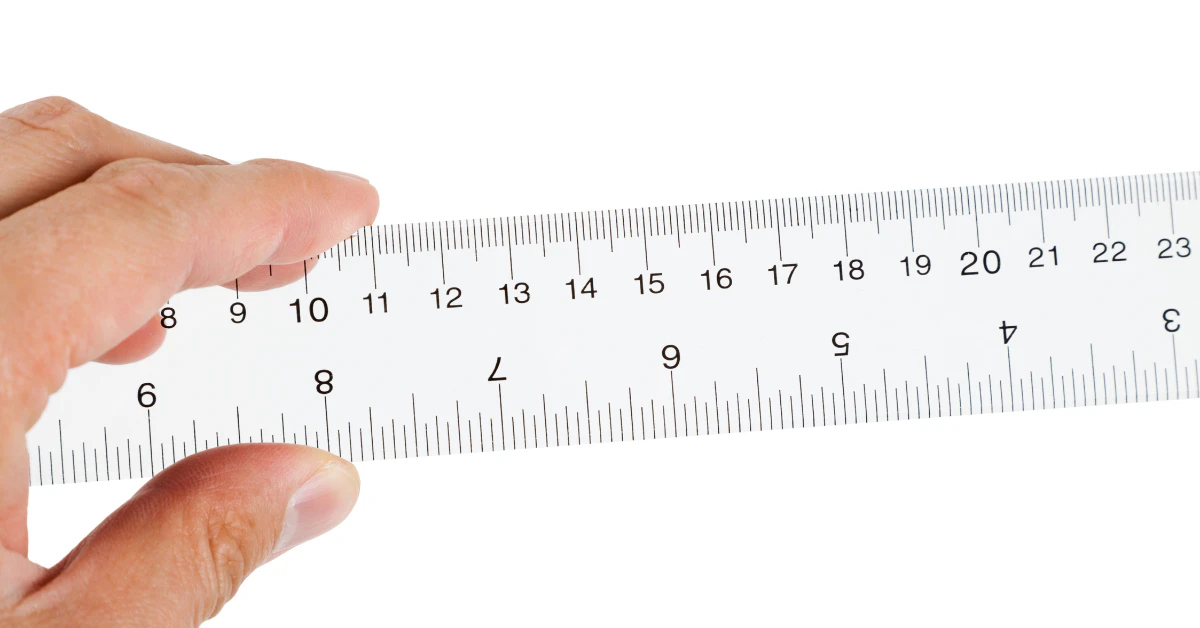
A standard 12 inch ruler is 30.48 cm long. Many people think 5 inches is the middle, but the middle is 6 inches (15.24 cm). Five inches is 41.7 percent of the way along, which you find by dividing 5 by 12. That is one inch before the halfway mark.
On the metric side, 5 inches is 12.7 cm, which is 7 mm past the 12 cm line. Line your object up with the zero line, not the end of the ruler, because some rulers have a small blank edge before zero.
US Letter Paper
US Letter paper is 8.5 by 11 inches (215.9 by 279.4 mm). The short side is 8.5 inches, so 5 inches is about 59 percent of it. Divide 5 by 8.5 to check. The answer is 0.588.
Here is a trick that uses a poker card from earlier. A poker card is 3.5 inches (88.9 mm) tall. Lay it along the short edge, mark where it ends, and fold there. The rest of the edge is 5 inches (127 mm), because 8.5 minus 3.5 is 5. This works only with US Letter. Paper from other countries, like A4, is a different size.
Standard Interior Door
A standard US interior door is typically 80 inches (6 feet 8 inches, or 203.2 cm) tall. Five inches is one sixteenth of that height. To see it, cut the door height in half four times. Eighty becomes 40, then 20, then 10, then 5.
Door height varies in older homes and custom builds, and widths range from 24 to 36 inches (61 to 91.4 cm). I use the door as a reminder that 5 inches is small. An error of 1 inch is 20 percent of the whole length.
Only the photo print is exactly 5 inches here. The passport and the soda can are near misses, and the pencil, ruler, paper, and door help you work out the length with simple math. Use the exact items when you need accuracy. Use the near misses for a quick check, and then confirm with a ruler.
Clothing and Sports Measurements

4.25 inches (108 mm) is the width of a golf hole, and 5 inches is wider than that. This section helps shoppers and sports fans see 5 inches in shoes, shorts, and golf gear. Each item names its measuring point, so you know exactly what is being compared.
A 5 Inch Shoe Heel
A 5 inch shoe heel is 12.7 cm tall, and it is considered a very high heel. Brands do not all measure it the same way. A common method measures the back of the heel from the floor to the point where the heel meets the shoe. Other brands treat the platform differently, so the number on the box can vary. Read the brand’s size chart before you buy.
To check a pair, stand the shoe on a flat table. Hold a ruler against the back of the heel and read the height at the top. A 5 by 7 photo print standing on its short edge is a good match too, because that edge is exactly 5 inches (12.7 cm).
5 Inch Inseam Shorts
The inseam runs along the inside of the leg, from the crotch seam down to the bottom hem. A 5 inch inseam (12.7 cm) is a popular short length for men. Do not confuse it with the outseam, which runs from the waistband to the hem and is longer.
The same inseam looks different on different bodies. A 5 inch inseam looks shorter on a tall person because their legs are longer. Inseams also vary by brand and size, so check the product page. To test a pair, lay the shorts flat and measure the inner seam.
Three Standard Golf Balls Lined Up
The Rules of Golf say a golf ball must be at least 1.680 inches (42.67 mm) wide. Three balls in a straight row measure at least 5.04 inches (128 mm). That is only 0.04 inches (1 mm) over 5 inches, which makes it one of the closest sports comparisons.
The rule sets a minimum size, not an exact one, so a row can run slightly longer. Line the balls up on a flat surface and press them together. Use this as a quick estimate, then always confirm with a ruler.
A Standard Golf Hole
A golf hole is exactly 4.25 inches (108 mm) wide, as set by the Rules of Golf. A 5 inch object would not fit inside it. The gap is 0.75 inches (19.05 mm), which is the width of a US penny (0.750 inches).
Two golf balls side by side measure 3.36 inches (85.34 mm), so they fit across the hole with room to spare. Three balls measure 5.04 inches (128 mm), which is wider than the cup. Next time you watch a putt drop, remember that the hole itself is narrower than 5 inches.
How to Estimate 5 Inches Without a Ruler
Need 5 inches fast, with no ruler in sight? Your hand looks like the easy answer, but it is a poor tool. Hand spans, palm widths, and finger lengths differ from person to person, so a guess can be off by a lot. I never trust my hand when accuracy matters.
Use money instead. A US one dollar bill is 6.14 inches (156 mm) long. Fold back 1.14 inches (28.96 mm) from one short edge, and the length from the crease to the other end is 5 inches (127 mm). That folded bill is your measuring tool.
Press the crease flat with your fingernail, then hold the folded bill against the object you want to measure. Line up the crease with one end and read where the bill ends. Test your fold once against a real ruler so you know how close your bill is. Another backup is the short edge of a 5 by 7 photo print, which is exactly 5 inches.
You may wonder how to find 1.14 inches without a ruler. It is a little more than an inch, and two coins help. A US dollar coin is 1.043 inches (26.49 mm) wide, so folding at its edge leaves about 5.1 inches. A half dollar is 1.205 inches (30.61 mm) wide and leaves about 4.94 inches. Either one gets you close. A worn bill can shift the result slightly, so use a clean one and confirm with a ruler when you can.
Now clear up one common mix up. 5 inches is not the same as 5 centimeters. Five centimeters is only about 1.97 inches, which is less than half the length. In the other direction, 5 inches is 12.7 cm. Check the unit on every label, size chart, and product page before you cut or buy.
Frequently Asked Questions
How Many Centimeters Is 5 Inches?
5 inches is exactly 12.7 centimeters, or 127 millimeters. This is because 1 inch is defined as 25.4 mm. To convert any inch value, multiply it by 2.54 to get centimeters. On a ruler, that is 7 mm past the 12 cm mark.
How Many Feet Is 5 Inches?
5 inches is about 0.4167 feet, which is five twelfths of a foot. A foot has 12 inches, so you divide 5 by 12. In yards, 5 inches is about 0.1389 yards. That is a little less than half a foot.
What Everyday Object Is Exactly 5 Inches Long?
The short side of a 5 by 7 photo print is exactly 5 inches. A 40d nail is also 5 inches long. The USPS minimum length for a postcard is 5 inches as well. Check the item itself, since frames and packaging can vary.
Is 5 Inches Longer Than a Dollar Bill?
No, it is shorter. A US one dollar bill is 6.14 inches (156 mm) long, so 5 inches is about 81 percent of its length. Two bills laid side by side on their short edges measure about 5.22 inches. That is 1.14 inches longer than 5 inches.
How Big Is a 5 Inch Phone Screen?
A 5 inch phone screen is measured on the diagonal, not the long side. On a 16 by 9 screen, it is about 4.36 by 2.45 inches. On a taller 20 by 9 screen, it is about 4.56 by 2.05 inches. Check the screen shape first.
Is 5 Centimeters the Same as 5 Inches?
No. 5 centimeters is only about 1.97 inches, which is less than half of 5 inches. To avoid mistakes, check the unit on every label before you buy it.
Conclusion
5 inches is 12.7 cm, and it falls between a golf hole at 4.25 inches and a dollar bill at 6.14 inches. Only a few items match it exactly, so I use the 5 by 7 photo print, six nickels, and the folded dollar bill. Near misses help for a quick check. When accuracy matters, confirm with a ruler. Now you can spot 5 inches around the house, at the store, or on the golf course.