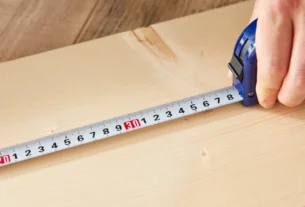
100 feet equals exactly 30.48 meters, or 1,200 inches, or 33.33 yards. That is the quick answer to how long is 100 feet. There is no rounding here, because one foot is defined as 0.3048 meters, so the math ends cleanly.
A number alone is hard to feel, though. I know it gets tricky when you plan a fence, a garden hose, or an extension cord and need to see the distance in your head. Two real objects help. On an NHL rink, the distance from the end boards to the center line is 100 feet, because the rink is 200 feet long. A Boeing 737 200 airplane is about 100 feet 2 inches (30.5 m) long from nose to tail.
Below, I walk through more objects you can picture, from sports fields to vehicles, plus a simple way to measure 100 feet without a tape.
100 Feet Conversion Quick Reference
Exact numbers matter when you buy materials, cut cable, or mark a layout, so here are the conversions for 100 feet in one place.
| Unit | Equal to 100 Feet |
| Inches | 1,200 |
| Centimeters | 3,048 |
| Millimeters | 30,480 |
| Meters | 30.48 |
| Yards | 33.33 |
| Miles | 0.0189 |
| Pixels (at 96 DPI) | 115,200 |
The pixel row is for digital designers. A screen set to 96 DPI uses 96 pixels for every inch, so 1,200 inches gives 115,200 pixels. The number changes if your file uses a different DPI, so check your settings first.
Yards and meters cause the most confusion. A yard is 3 feet, so 100 yards is 300 feet (91.44 m), three times as long as 100 feet. Ordering 100 yards of rope when you only need 100 feet means buying 200 feet too much. That is why a football field, which is 100 yards between the goal lines, feels so much bigger than the distance on this page. A meter is about 3.28 feet, so 100 meters is roughly 328 feet. Runners know 100 meters as a sprint, but it is more than three times 100 feet.
A quick check: divide feet by 3 to get yards, and divide feet by 3.28 for a close meter estimate. For 100 feet, that gives 33.33 yards and about 30.5 meters. Both shortcuts work for any distance.
Visualizing 100 Feet in the Sports World
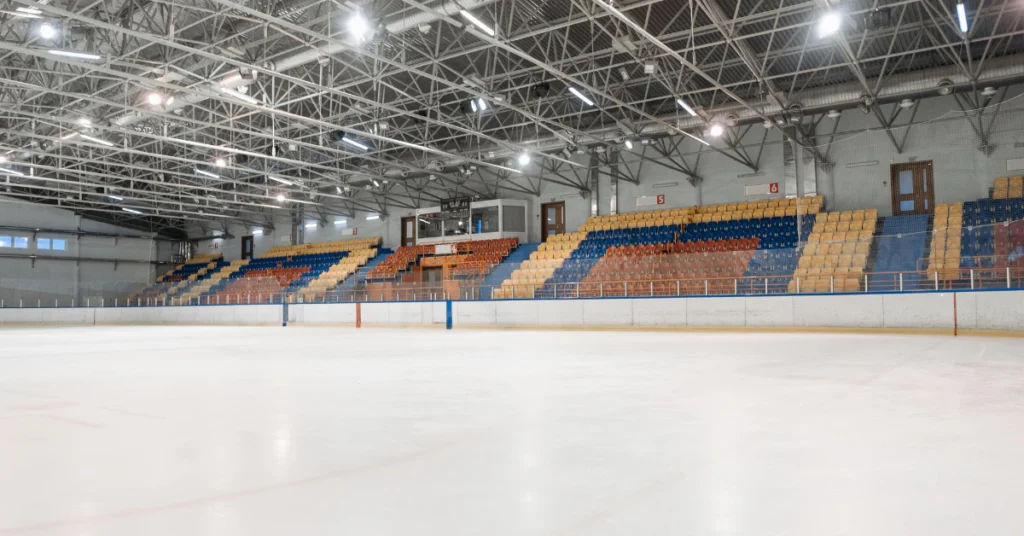
Sports venues are handy for measuring because their rulebooks set the sizes. Here are six that show how far 100 feet really is.
NHL Rink
The center line of an NHL rink is exactly 100 feet (30.48 m) from the end boards. That works because the rink is 200 feet (60.96 m) long and 85 feet (25.91 m) wide, and the center line marks the halfway point. It is one of the cleanest matches for this length, since it needs no rounding and no math. Rinks used in international play can be different. They range from about 184 to 200 feet long and 85 to 98 feet wide, so I use the NHL size here. On TV, the stretch from the end boards to the red line in the middle is a fair picture of 100 feet. If you have ever watched a puck slide the whole length of the ice, that trip covers two of these 100 foot sections.
NFL Field
A football field is three times as long as 100 feet, if you measure from goal line to goal line. The NFL playing field runs 300 feet (91.44 m) between the goal lines, so 100 feet is exactly one third of it, or 33.3 percent. Each end zone adds 30 feet (9.14 m), which brings the full field to 360 feet (109.73 m) long and 160 feet (48.77 m) wide. You may see 27.8 percent online. That number is also correct, but it divides 100 feet by the full 360 feet, end zones included. I use the 300 foot playing field because that is how people usually talk about a football field. You can confirm the field sizes in the official NFL rulebook. Walk from a goal line a little past the 33 yard line, and you have covered 100 feet.
NBA Court
An NBA court is 94 feet (28.65 m) long, which is just 6 feet (1.83 m) short of 100 feet. That makes it the closest match on this list. The court is 50 feet (15.24 m) wide, so 100 feet is exactly twice its width. To picture the distance, think of one baseline to the other, then add two or three steps. A typical adult step is about 2.5 feet (0.76 m), so 6 feet is a little over two steps. Courts built to international rules are a bit shorter, at 28 meters (about 91.9 feet), so check which court you mean before you compare. If you want a fast test, walk the length of an NBA court and count your steps. With a 2.5 foot step, you take about 38 steps to cover 94 feet and 40 steps to cover 100 feet.
Bowling Lane
Tip: use a bowling lane as your measuring stick. The distance from the foul line to the head pin is 60 feet (18.29 m), so 100 feet is about 1.67 lanes. That is one full lane plus two thirds of another. Lane lengths are tightly controlled. The United States Bowling Congress allows a range of only 59 feet 11 and a half inches to 60 feet and a half inch, so 60 feet is a trustworthy number. The full lane, measured to the end of the pin deck, is longer at about 62.8 feet (19.16 m). These two numbers are easy to confuse, so I list both. Neither one equals 100 feet, but both help you scale it. Next time you watch bowling, look from the foul line to the pins and then add about 40 more feet in your head.
Baseball Infield
A baseball infield is a 90 foot square, so the bases are 90 feet (27.43 m) apart. The official baseball rules describe the infield this way, which makes 90 feet a number you can trust. The same 90 feet applies to every side of the diamond, so all four base paths are equal. A run from home plate to first base covers 90 feet, just 10 feet (3.05 m) short of 100 feet. Keep going about four more steps past the bag and you reach 100 feet. The diagonal across the diamond, from home plate to second base, is longer, at about 127.3 feet (38.8 m). That comes from multiplying the 90 foot side by 1.414, the square root of 2. So the next time you see a runner dig for first, you are watching 90 feet. Add a short cooldown jog, and you have 100 feet.
Pickleball Court
A pickleball court is much smaller than the other venues here, so you need more than two of them to reach 100 feet. The court is 44 feet (13.41 m) long and 20 feet (6.10 m) wide, and the net crosses the middle at 22 feet (6.71 m) from each end. Two courts placed end to end make 88 feet (26.82 m), and 12 more feet (3.66 m) gets you to 100 feet. In other words, 100 feet is about 2.27 pickleball courts. Doubles and singles games use the same court size, which makes this a clean number to remember. If your local park has a pickleball area, count how many courts fit end to end. Three courts in a row cover 132 feet, so two and a bit gets you right to the mark.
Highway Vehicles and Freight

You are cruising down the interstate, and trucks, buses, and freight all roll past. These everyday highway sights make 100 feet easy to judge.
Shipping Containers
A standard shipping container is 40 feet (12.19 m) long, so two and a half of them equal 100 feet. This size comes from the ISO 668 standard, which defines a 40 foot container as 12.192 meters. Because the length is set by an international standard, you can count on it across shipping lines. Stack two end to end and you have 80 feet (24.38 m). Add half of a third one and you reach 100 feet. Containers are easy to spot on trains, ships, and trucks, so they make a handy mental ruler. A 20 foot container, the other common size, is half as long, so five of them make 100 feet. If you see a truck hauling a single 40 foot container, picture two and a half of them in a row.
Transit Buses
A city transit bus often comes in a 40 foot model, but the exact length depends on the maker and the model. One popular example, the New Flyer Xcelsior, is built in 35, 40, and 60 foot versions. The 40 foot version measures about 41 feet (12.50 m) when you count the bumpers, so 100 feet is about 2.4 buses. The 60 foot version bends in the middle and is called an articulated bus. Park one articulated bus and one 40 foot bus end to end, and you get close to 100 feet. Because bus lengths vary, treat 40 feet as a rounded figure, not an exact one. If you check a transit agency’s fleet page, you can find the exact length of the bus on your route.
School Buses
A large school bus is roughly 40 feet long, but the length depends on the model and the number of seats. A school bus is a great comparison because many people in the US have seen one up close, and its size is easy to judge from the curb. A Florida school bus specification table lists a Blue Bird model for 47 students at 362.9 inches (30.2 feet, 9.22 m), while an 84 student Type D bus is 493.7 inches (41.1 feet, 12.54 m). That means 100 feet is somewhere between 2.4 and 3.3 school buses. Many are about 8 feet (2.44 m) wide, so the width is easier to compare than the length. When you see a big yellow bus, use 40 feet as a quick guess, then adjust down for smaller buses.
Semi Trailers
The federal minimum length that states must allow for a semi trailer is 48 feet (14.63 m), so two trailers parked end to end measure 96 feet (29.26 m), just shy of 100 feet. Many states allow longer trailers of 53 feet (16.15 m), and two of those add up to 106 feet (32.31 m), a little over the mark. So 100 feet falls between the two. That is why trucks are such a handy ruler on the road. Remember that these numbers cover the trailer only. The cab that pulls it adds more length, so a full truck is longer than its trailer. If you want a fast visual, find a trailer on a highway or in a parking lot and think of it as about half of 100 feet. For a 48 foot trailer, that is off by only 2 feet.
Aviation, Landmarks, and Nature

Here is a surprising fact: a Boeing 737 200 jet is only 2 inches longer than 100 feet, while the first powered airplane flight in history covered 120 feet. The items below turn a plain number into something huge and easy to understand.
Fire Engine Aerial Ladder
Many fire trucks carry an aerial ladder rated for 100 feet (30.48 m) of reach. One example is a Pierce 100 foot aluminum ladder, which reaches 100 feet straight up when fully raised. It reaches a little less when stretched sideways. The maker lists about 91 feet 7 inches (27.92 m) of horizontal reach for the aluminum model and about 93 feet (28.35 m) for a steel model, so ratings vary by model. Keep in mind that this is a reach number, not the length of the truck, which is much shorter. Because it is a rated reach, check the exact model before you rely on the number. Next time you see a ladder truck with its ladder raised, look at the tip and think of a 100 foot climb straight up.
Space Shuttle Orbiter
The Space Shuttle orbiter was 122 feet (37.19 m) long, according to NASA, so 100 feet is about 82 percent of its length. Its wingspan was 78 feet (23.77 m). It stood 57 feet (17.37 m) tall, a little more than half of 100 feet. A simple way to remember the length is 100 feet plus 22 extra feet. NASA also lists the full shuttle stack, with the orbiter, fuel tank, and boosters, at 184 feet (56.08 m) tall. That is nearly double the 100 foot mark. Compared with the next item on this list, the orbiter is about 22 feet longer than a Boeing 737 200 airliner. So if you can picture the shuttle parked on a runway, you are picturing something about a fifth longer than 100 feet.
Boeing 737-200
A Boeing 737 200 airliner is 100 feet 2 inches (30.53 m) long, according to Boeing’s airport planning documents. That makes it only 2 inches longer than 100 feet, one of the closest matches in this entire article. The 737 family is not all the same size, though. The original 737 100 was 94 feet (28.65 m), the 737 500 is 101 feet 9 inches (31.01 m), the 737 700 is 110 feet 4 inches (33.63 m), and the 737 800 is 129 feet 6 inches (39.47 m). So only the 200 and the 500 are near 100 feet. The 737 800 is about 29 feet (8.94 m) longer than the 737 200, close to the length of a small school bus. Because the length depends on the exact model, always name the model when you compare.
Wright Brothers First Flight
On December 17, 1903, Orville Wright piloted the Wright Flyer on the first powered flight at Kitty Hawk, North Carolina. It covered 120 feet (36.58 m) in 12 seconds, at about 6.8 miles per hour (10.9 kilometers per hour), according to NASA. That is 20 feet farther than our 100 foot target. The longest flight that day was the fourth one, which covered 852 feet (259.69 m) in 59 seconds. That is more than eight times the 100 foot mark. The first flight was about as long as the Space Shuttle orbiter, which is 122 feet, so both are a bit past 100 feet. It is a neat way to see how far aviation has come: the whole first flight fits within the length of a Space Shuttle orbiter.
The Blue Whale
A blue whale can reach up to about 100 feet (30.48 m) long, according to NOAA. That puts it very close to 100 feet. The best documented blue whale measured about 98 feet (29.87 m), just 2 feet shy of the mark. That is nearly the same length as a Boeing 737 200 airliner, which is 100 feet 2 inches. Older claims of whales near 110 feet are hard to confirm, so I stick to documented numbers. For another comparison, a 98 foot whale is roughly two to three school buses end to end, since a school bus runs about 30 to 41 feet. The next time you see a whale in a nature film, remember that a blue whale can be as long as a jet airliner.
A 10-Story Building
A 10 story building is roughly 100 feet (30.48 m) tall if you assume 10 feet (3.05 m) per floor. That is a handy rule of thumb, but real floor heights vary by building type. Offices, stores, and homes use different floor heights, so the true height can land above or below 100 feet. Treat this as a quick guide, not an exact measurement. Think of a basketball rim, which is 10 feet above the court. Stack ten of those rims on top of each other and you reach about 100 feet. When you look up at a 10 story building, you are looking at roughly ten basketball rims stacked up. If a building has fewer floors, count them and multiply by about 10 feet for a fast estimate.
Everyday Objects and Trade Tools
Grab a dollar bill and a credit card from your wallet. Each one is tiny, yet laid end to end they stretch into 100 feet. A classic surveying tool and a common network cable round out this list.
The Engineers Chain
Fun fact: there was once a tool made for exactly this job. An engineer’s chain is a measuring chain that is exactly 100 feet (30.48 m) long, made of 100 links that are each 1 foot (30.48 cm) long. Surveyors used it to measure land before modern tools took over. Because each link is one foot, you can count links to read the distance: 50 links is 50 feet, and all 100 links is 100 feet. It should not be confused with the better known Gunter’s chain, which is 66 feet (20.12 m) long and also has 100 links. The links in that chain are 7.92 inches (20.12 cm) each. So when someone says chain, ask which kind they mean. The engineer’s chain is the one that matches 100 feet exactly, so it is a neat link between old surveying and modern measuring.
Cat6 Ethernet Cable
Tip: before you buy a network cable, check the length against the Ethernet limit. A Cat6 Ethernet cable run has a maximum of 328 feet (100 m) for a full channel, which is usually a 295 foot (90 m) permanent cable plus 33 feet (10 m) of patch cords. So a 100 foot (30.48 m) cable uses about 30.5 percent of that limit. The 328 foot rule is 100 meters, a round number in the metric system, which is why it looks odd in feet. That leaves plenty of room, so you can run a cable across a house or a garage without worrying about the cap. Real routes bend around walls and corners, so a cable run is longer than the straight distance. Measure the path with a string first, then buy a cable a little longer.
US Dollar Bills
Grab a dollar bill and measure it: a US bill is 6.14 inches (15.6 cm) long, which makes it a handy small ruler. It takes about 195 bills laid end to end to reach 100 feet, because 1,200 inches divided by 6.14 is 195.4. So 195 bills cover about 99.8 feet (30.4 m), and a 196th bill takes you past the mark. All current US bills share the same size, so the denomination does not change the count. A row of 195 one dollar bills would be worth 195 dollars, which shows how a tiny everyday object turns into a long line. The width is 2.61 inches (6.63 cm), so laid side by side it would take about 460 bills to cover the same distance. Use a ruler to check your own bill, since a worn or folded bill may measure a little differently.
Standard Credit Cards
A standard credit card is 3.370 inches (85.60 mm) long, so it takes about 356 cards laid end to end to reach 100 feet. That size comes from the ISO and IEC 7810 standard for ID 1 cards, the format used by most bank cards. The math is 1,200 inches divided by 3.370, which equals 356.1. At 356 cards, you cover 99.98 feet (30.47 m), which is almost exactly the full distance. The card is 2.125 inches (53.98 mm) wide. Because an international standard sets the size, the count does not change from one bank or brand to another. Many other wallet cards follow the same size, so you can use them the same way. Lay a few cards down in a row to feel how fast the inches add up.
How to Measure 100 Feet Without a Tape Measure

Here is a step by step method for finding 100 feet when no tape is nearby.
- Find your step length. Measure 10 feet (3.05 m) once with a tape, walk it naturally, and count your steps. Divide 10 by your count to get your step in feet.
- Count your steps. Walk in a straight line at a normal speed and count each step as one foot lands.
- Stop at your number. Use the step counts below, or divide 100 by your own step length.
A step is one foot moving forward, about 2.5 feet (0.76 m) for an average man. A pace is two steps, from one foot landing to that same foot landing again, so it is about 5 feet (1.52 m). Some sources use pace for a single step, so I define it this way here. The difference matters: counting 40 paces would take you about 200 feet, not 100.
For an average man, 100 feet takes about 40 steps at 2.5 feet each. For an average woman, a step is about 2.2 feet (0.67 m), so it takes roughly 45 steps. In paces, that is about 20 for a man and about 23 for a woman.
Time works too. At a normal walking speed of 3 miles per hour (4.8 kilometers per hour), 100 feet takes about 22.7 seconds. A brisk 4 miles per hour (6.4 kilometers per hour) cuts that to about 17 seconds.
This mental math helps when you estimate a garden hose, a fence run, or the spacing of plants. I would pace it out first, then buy materials with a little extra. Your stride changes on hills, grass, or when you carry a load, so treat the result as an estimate. For property lines or anything legal, rely on a tape or a professional survey.
Common Mix-Ups When Visualizing Lengths
Myth: 100 feet and 100 yards are close enough to swap. Fact: 100 yards is 300 feet (91.44 m), which is three times as long as 100 feet (30.48 m). This mistake is costly in both directions. If you need 100 yards of fence wire and buy 100 feet, you end up 200 feet (60.96 m) short. If you need 100 feet and buy 100 yards, you pay for 200 feet (60.96 m) you will not use. Always check the unit on the package before you pay. A quick glance at the label can save you real money.
Here is a more technical twist. The US survey foot, an older version of the foot used in land surveying, was officially deprecated by NIST on December 31, 2022. It sounds major, but the numbers are tiny. The survey foot is slightly longer than the international foot, by about 2 parts per million. Over 100 feet, that adds up to only 0.061 millimeters (0.0024 inches).
My tip: for fencing, wire, cable, or hose, you can ignore this change. A gap that small is far too small to see on a tape measure. Make sure you are using feet, not yards or meters.
Frequently Asked Questions
How many meters is 100 feet?
100 feet is exactly 30.48 meters. That also equals 1,200 inches, 3,048 centimeters, and 33.33 yards. The conversion is exact because one foot is defined as 0.3048 meters, so no rounding is needed. That makes it easy to scale: 10 feet is 3.048 meters, and 50 feet is 15.24 meters.
How many steps is 100 feet?
It takes about 40 steps for an average man (2.5 feet per step) and about 45 steps for an average woman (2.2 feet per step). Taller people take longer steps, so their count will be lower. Your own number depends on your height and walking style, so measure 10 feet once, count your steps, and divide 10 by the count.
How long does it take to walk 100 feet?
At a normal walking speed of 3 miles per hour, it takes about 22.7 seconds. That is about 4.4 feet per second, which is a handy number to remember. At a brisk 4 miles per hour, it takes about 17 seconds. Hills, crowds, and heavy loads will slow you down.
Is 100 feet the same as 100 yards?
No. 100 yards equals 300 feet (91.44 m), which is three times as long as 100 feet. A simple rule helps: multiply yards by 3 to get feet. So 100 yards becomes 300 feet, and 100 feet is only 33.33 yards. Check the unit before you buy fencing, rope, or wire.
How does 100 feet compare to a football field?
An NFL playing field is 300 feet between the goal lines, so 100 feet is exactly one third of it, or 33.3 percent. Including both end zones, the field is 360 feet, and 100 feet is about 27.8 percent. Walk from a goal line to just past the 33 yard line, and you have covered 100 feet.
What objects are about 100 feet long?
An NHL rink measures 100 feet from the end boards to the center line. A Boeing 737 200 airliner is 100 feet 2 inches (30.53 m) long. A blue whale can reach up to about 100 feet, according to NOAA. Laid end to end, about 195 dollar bills or 356 credit cards also reach 100 feet. Vehicles like buses and ladder trucks vary by model, so use them as close guides.
Final Thoughts
100 feet is exactly 30.48 meters, and now you have plenty of ways to see it. An NHL rink gives you a clean match, since the center line is exactly 100 feet from the end boards. A Boeing 737 200 is just 2 inches over. A wallet gives you 195 dollar bills or 356 credit cards, and your own legs give you about 40 to 45 steps.
Keep two things in mind. Some objects, like buses and ladder trucks, vary by model, so treat them as close guides. And always check whether a label says feet or yards before you buy anything.
Next time you need 100 feet, pick the comparison that fits your project and count it out.